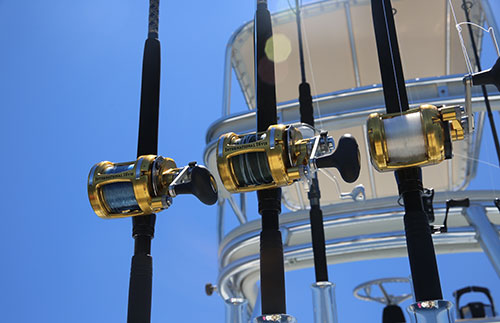
Blue Water, Yellow Fins….Where The Gulf Stream Meets The Shelf Edge
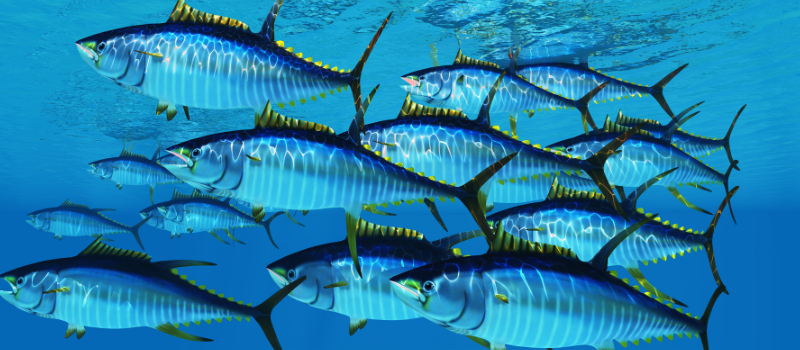
Sixty miles off the coast of Morehead City, the ocean floor drops away like a broken promise. The Continental Shelf ends, the bottom falls thousands of feet, and the cobalt pulse of the Gulf Stream sweeps north in a warm, living river. This is the Carolina Shelf Edge, and in the late spring and early fall, it belongs to the yellowfin tuna.
The run starts as the water temperatures climb above 70 degrees and the bait, pogies, flying fish, squid, stacks up along the temperature breaks. Word spreads fast on the docks of Hatteras, Beaufort, and Wrightsville Beach. Boats start leaving before midnight to beat the two-hour run offshore.
Once there, captains face a choice as old as the fishery itself: do you troll, or do you chunk?
“Trolling puts you in the fish. Chunking brings the fish to you. Both will ruin your arms and your sleep schedule in equal measure.”
Trolling is speed and search. Captains run lures, skirted ballyhoo, cedar plugs, bird-and-bait combos, spread across a pattern of flat lines, short riggers, long riggers, and a center shotgun. The boat moves at seven or eight knots while the spread mimics a fleeing school of bait. When a yellowfin fires on a lure, the rod loads, the clicker screams, and chaos erupts. Multiple hookups at once are common. The fish run hard and fast, stripping drag in long, burning pulls. On a good troll bite, you never stop moving, the captain marks a school on the sonar, wheels the boat back through the commotion, and the whole beautiful madness starts again.
Chunking is patience turned into art. The boat drifts. Mates quarter fresh-cut Atlantic menhaden, chunk by chunk, over the stern, building a slick that stretches downcurrent like a dinner invitation written in oil and scales. Anglers freelined pieces of cut bait back through the same slick on circle hooks, no weight. The wait can be long. The water might be empty for twenty minutes. And then the yellowfin arrive, first as dark shapes milling at forty feet, then at thirty, then right at the surface, slashing through the chum, their golden-yellow finlets catching the sun. The angler feeds line forward, hesitates, then the circle hook finds the jaw. The fight is personal: you and a hundred-pound animal, no boat moving you along, just the rod and the reel and your knees braced against the gunwale.
Most Carolina regulars will tell you they love both, but that chunking gets under your skin differently. There’s something in watching those fish rise through blue water, something ancient and electric about knowing they chose your bait, right now, right here. The shelf edge gives you that. Come find it.

You may be interested
This Week’s Offshore Conditions Forecast
Tim Wilson - September 25, 2026The latest in offshore conditions. Click for full information. https://youtu.be/SZ3JnOloRHE?si=zuBbxUQhw3Gcah63 https://youtu.be/o03wbLuGckI?si=FL1jlf_-gvISsJ8O
Trust and the Future of North Carolina’s Fisheries……Chapter 6
Tim Wilson - September 24, 2026The conflict surrounding North Carolina’s marine fisheries has never been only about fish. For many fishermen, it is also about whether the people making decisions understand what…
An Angler Looks At 70
Tim Wilson - September 24, 2026Growing up in the foothills of North Carolina, fishing was a far cry from fishing on the Carolina coast. However, fishing in my early years is something…
Most from this category
Early Deer Season…. Why September Whitetails Require a Different Strategy
Tim Wilson - September 24, 2026
Follow the Bait….Follow the Bait: Why Finger Mullet Can Tell You Where the Fish Are
Tim Wilson - September 24, 2026