What’s That Sound Under Your Boat?
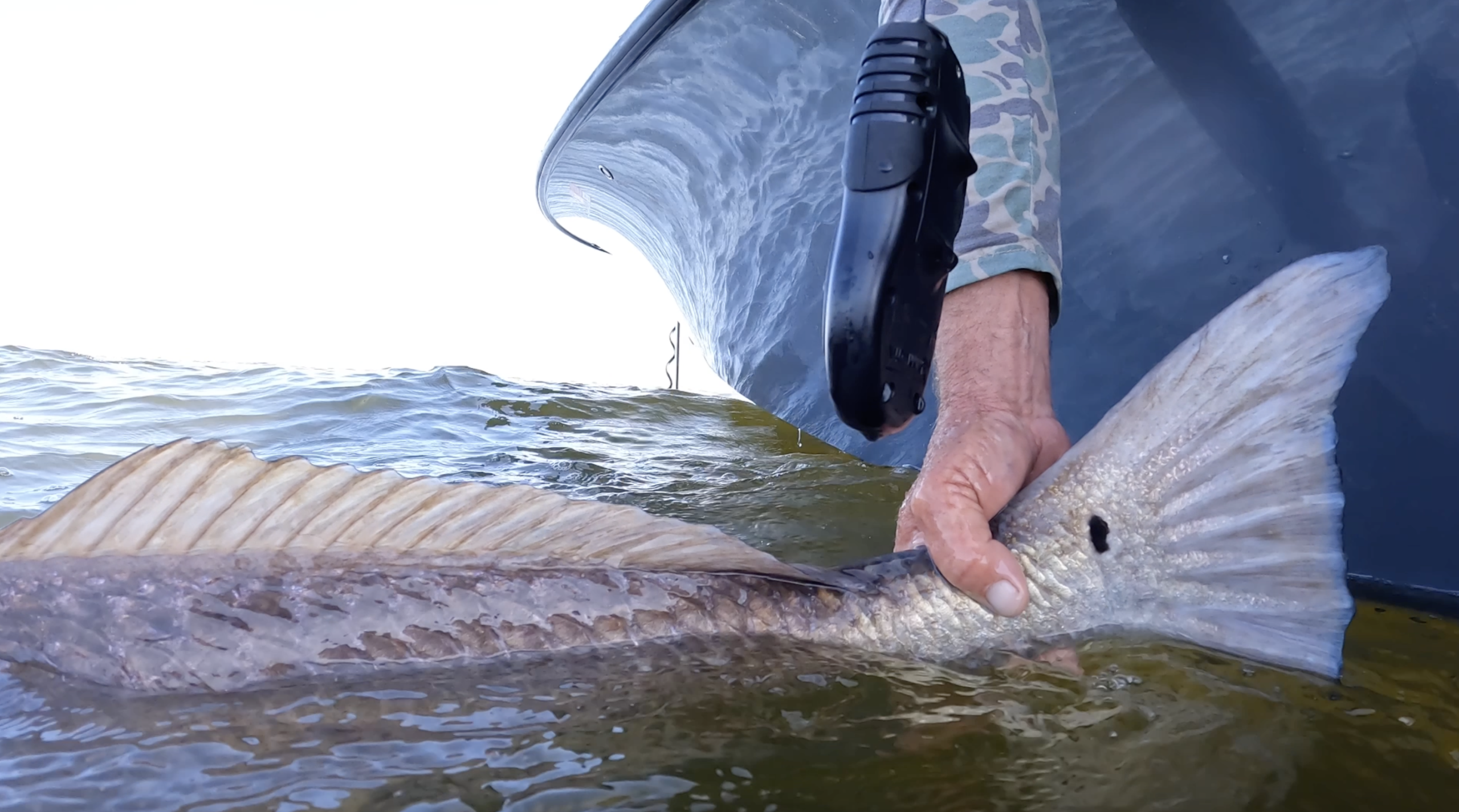
Anchor up in Pamlico Sound on a quiet fall evening, cut the engine, and listen. On the right night, especially in September and October, you might hear something strange radiating through the hull of your boat—a low, rhythmic thrumming that seems to rise from somewhere deep and close all at once. What you’re hearing is red drum, doing exactly what they’ve been doing for tens of millions of years: talking.
Red drum, spotted seatrout, croakers, weakfish, and the rest of the Sciaenidae family are among the most acoustically active fish on the planet. Specialized sonic muscles attach directly to the swim bladder—the gas-filled organ that controls buoyancy—and when a drum wants to be heard, those muscles contract at extraordinary speed, making the swim bladder vibrate like the skin of, well, a drum. The result is a low-frequency pulse that carries hundreds of meters through shallow water.
“Sound travels roughly five times faster underwater than in air—about 1,500 meters per second—making acoustics far more effective than visual signals in dark or murky estuarine waters.”
Each species in the family has its own acoustic fingerprint. Red drum produce a series of deep, repeated pulses that resonate across the estuary. Spotted seatrout have a more complex, staccato-style call. Black drum are unusual even among sciaenids. Both sexes call, not just the males. Experienced researchers and a few longtime anglers can tell them apart by ear alone.
Sound isn’t just a novelty for these fish; it’s central to reproduction. Males are the primary callers, and their drumming intensifies during spawning season, peaking around dusk as water temperatures and lunar cycles align. It’s a biological advertisement, a way of announcing fitness and location to potential mates in waters where visibility may extend only inches. Those evening choruses aren’t random noise. They are, quite literally, the sound of a new generation beginning.
Not all sciaenids rely solely on the swim bladder. Some use stridulation, rubbing together bony structures like teeth or fin spines to produce clicks, rasps, and grunts. The ocean has never been the silent world we once imagined. Fish have been communicating acoustically for at least 155 million years.
You may be interested

This Week’s Offshore Conditions Forecast
Tim Wilson - September 11, 2026The latest in offshore conditions. Click for full information. https://youtu.be/yJWJ_XJ7Aug https://youtu.be/b0SJPKj3fN8

A Carolina Coast Fishing Icon Passes….Captain Robbie Wolve
Tim Wilson - September 11, 2026The Carolina fishing community lost one of its own with the passing of longtime charter fisherman Captain Robbie Wolfe, who died peacefully at his Wilmington home on…

Catching GIANT Flounder Around Docks in NORTH CAROLINA
Tim Wilson - September 11, 2026Flounder are masters of disappearing, but Capt. Jot Owens knows exactly where to look. C.A. Richardson heads to Wrightsville Beach, North Carolina, to join renowned inshore guide…
Most from this category