Wahoo Fishing…..Knowing The Basics and Whys
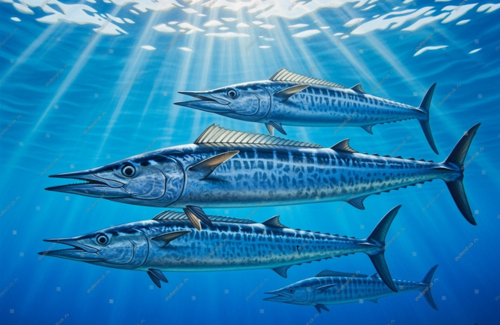
Wahoo have earned a reputation as one of the fastest and most exciting game fish in the ocean. Capable of reaching speeds approaching 50 miles per hour, they are built for explosive bursts of speed and violent strikes that can leave an angler breathless. While many offshore species require patience, wahoo fishing often rewards anglers who understand where these predators hunt and how to present a lure that triggers their instinct to attack.
The first key to successful wahoo fishing is understanding their habitat. Wahoo spend most of their lives in warm, blue offshore waters, often along the edges of the Gulf Stream, temperature breaks, underwater ledges, wrecks, reefs, and steep drop-offs. These locations concentrate baitfish such as flying fish, bonito, and small tuna, providing an ideal feeding ground. Wahoo are ambush predators, preferring to use structure and current changes to surprise unsuspecting prey. Before setting your lines, study your chart plotter and fish finder for bait schools and areas where water temperatures change, as these are often the most productive places to fish.
Speed is one of the most important factors in catching wahoo. Unlike many offshore species that prefer slower-moving baits, wahoo are attracted to fast-moving lures that imitate a fleeing baitfish. High-speed trolling between 12 and 18 miles per hour allows anglers to cover more water while presenting a lure that matches the fish’s aggressive feeding behavior. If you’re using diving plugs or rigged natural baits, slowing to 6 to 8 miles per hour is generally more effective because these presentations work best at moderate speeds.
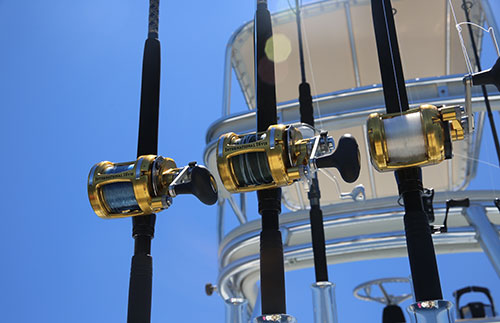
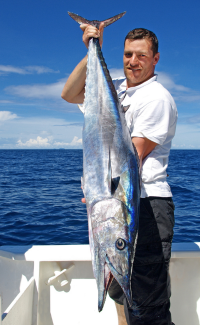 Selecting the proper tackle is equally important. Wahoo possess razor-sharp teeth capable of cutting through heavy monofilament or fluorocarbon leaders in an instant. For that reason, experienced anglers use short wire leaders or heavy cable ahead of the lure. Heavy-duty conventional reels filled with braided line or high-test monofilament provide the strength needed to handle blistering runs while maintaining control of the fish during the fight.
Lure selection often comes down to confidence and water conditions, but several colors consistently produce results. Purple and black, blue and white, pink, and black with red accents have long been favorites among offshore captains. Bullet-head lures, jet-head lures, and deep-diving plugs all have proven track records. Running one or two lures behind planers is another effective strategy because it places the bait deeper in the water column, where larger wahoo frequently cruise during bright daylight hours.
When a wahoo strikes, resist the temptation to immediately pull back on the throttles. Continue moving forward for a few seconds, allowing the fish to fully hook itself before clearing the remaining lines. Once the fish is close to the boat, use extreme caution. Wahoo remain powerful until the very end, and their teeth can cause serious injuries. A quality gaff and careful teamwork are essential for bringing the fish aboard safely.
Successful wahoo fishing is a combination of preparation, location, speed, and attention to detail. By fishing productive offshore structure, trolling at the proper speed, using wire leaders, and presenting proven lures, anglers greatly improve their chances of connecting with one of the ocean’s fastest and most thrilling game fish. Every strike is sudden, every fight is memorable, and every successful catch is a reward for understanding how this remarkable predator hunts.
You may be interested

This Week’s Offshore Conditions Forecast
Tim Wilson - September 11, 2026The latest in offshore conditions. Click for full information. https://youtu.be/yJWJ_XJ7Aug https://youtu.be/b0SJPKj3fN8
A Carolina Coast Fishing Icon Passes….Captain Robbie Wolve
Tim Wilson - September 11, 2026The Carolina fishing community lost one of its own with the passing of longtime charter fisherman Captain Robbie Wolfe, who died peacefully at his Wilmington home on…

Catching GIANT Flounder Around Docks in NORTH CAROLINA
Tim Wilson - September 11, 2026Flounder are masters of disappearing, but Capt. Jot Owens knows exactly where to look. C.A. Richardson heads to Wrightsville Beach, North Carolina, to join renowned inshore guide…
Most from this category